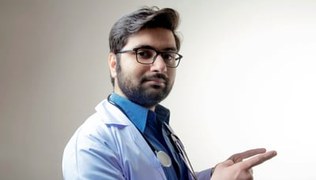
Robert Garcia
End-stage osteoarthritis of the right knee with varus deformity. Robert presented with a three-year history of progressively worsening right knee pain, marked restriction of mobility, and complete failure of conservative management including physiotherapy, weight reduction, intra-articular corticosteroid injections, and hyaluronic acid therapy. Weight-bearing radiographs demonstrated severe medial compartment joint space loss, large osteophyte formation, and subchondral sclerosis. He underwent primary right total knee arthroplasty using a cruciate-retaining implant under spinal anaesthesia.
Robert Garcia spent three years watching his world shrink. At sixty-one, the retired construction foreman had always prided himself on staying active — hiking with his wife on weekends, playing football in the garden with his grandchildren, keeping up with the demands of a large family. But the pain in his right knee had gradually taken all of that away. By the time he was referred to the Silvaris Orthopedic Institute in Tampa, he was walking with a pronounced limp, relying on a stick, and waking multiple times a night from the aching that no over-the-counter painkiller could fully quieten.
His orthopaedic consultant reviewed his imaging and was direct: the medial compartment of his knee was completely worn through. There was no cartilage left between the bones. Conservative treatment had already been exhausted, and the deformity was worsening. Total knee replacement was the recommended next step. Robert had been quietly dreading this conversation for months, but hearing the options laid out clearly — along with a frank discussion of what his quality of life would look like in five years without surgery — made the decision straightforward. "I came in hoping for a magic injection," he laughs. "I left ready for surgery."
The operation itself lasted ninety minutes. Robert was walking with the physiotherapist's assistance within twenty-four hours of surgery, which astonished him. The nursing team managed his pain meticulously, using a combination of regional nerve blocks and oral analgesia to keep him comfortable enough to participate in rehabilitation from the start. "I expected to be flat on my back for days," he says. "Instead I was up the next morning doing step exercises. It was uncomfortable, but possible, and possible made all the difference to my mindset." He was discharged home on day three with a full outpatient physiotherapy programme arranged.
The first six weeks at home were challenging. Robert's wife became his rehabilitation partner, helping him through his twice-daily exercise programme and accompanying him to his outpatient physiotherapy sessions three times a week. Swelling and stiffness were the main hurdles, but his physiotherapist adapted the programme week by week as his range of motion improved. By week eight, Robert had discarded his walking stick. By week twelve, he was taking short walks in the neighbourhood without assistance. "Every milestone felt huge," he says. "The physio team celebrated each one with me, and that encouragement kept me going on the days I wanted to give up."
Six months after surgery, Robert completed a two-kilometre charity walk alongside his wife and three grandchildren — an event he had assumed was permanently beyond him. His follow-up X-rays showed perfect implant positioning and no complications. He continues to see his orthopaedic consultant annually. The activity restrictions he was given — avoiding high-impact sport, protecting the implant — are a small price to pay for what he has regained. "I have my life back," Robert says simply. "The grandkids don't know why Grandad can suddenly keep up with them again. I just tell them I had a tune-up."